
Did Peace Bring Justice?
Collaborators, Justice, and Its Limits after WW2.

On the morning of June 3rd, 1946, Chen Gongbo was led out to be shot.
The date was not accidental. June 3rd was Opium Suppression Day. That is the anniversary of Lin Zexu’s destruction of British opium stockpiles in 1839, the act that had triggered the First Opium War. Chinese nationalists had commemorated that event as a symbol of resistance to foreign exploitation. We met Lin Zexu very early in this series. We have also met Chen Gongbo. He was the man who succeeded Wang Jingwei as head of the Reorganized National Government in Nanjing after Wang’s death in November 1944. He was the man whose regime had reduced punishments for the opium trade while publicly honouring Opium Suppression Day as theatre.
His trial had been held in Suzhou in April 1946, before a special military tribunal. The charges included treason and, specifically, narcoticizing the Chinese people. Specifically, facilitating the Japanese-controlled opium trade that had spread addiction deliberately through occupied China. His defense was, in its way, not without logic. He had not sought the presidency of the puppet regime, he argued. He had taken it because someone had to, and because he believed he could moderate the worst Japanese demands and protect Chinese civilians from greater harm. He had, he said, tried to serve China within impossible constraints.
The tribunal was not persuaded. He was convicted and sentenced to death. And on June 3rd — Opium Suppression Day — the man who had presided over the opium-enabling regime of occupied Nanjing was executed.
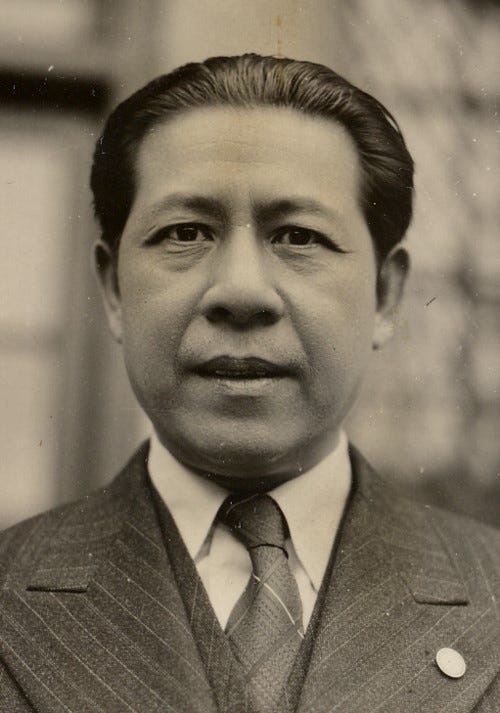
It was, in its symbolism, a satisfying verdict. Whether it was justice is a more complicated question.
Japan’s surrender in August 1945 left China facing a reckoning that went far beyond the military and geopolitical questions I have been describing. More than two hundred million Chinese had lived under Japanese occupation in various forms: in Manchukuo, in Wang Jingwei’s Nanjing regime, in the North China puppet government, in occupied Shanghai, in Taiwan. Some had served those regimes actively. Some had survived within them without serving. Most had simply tried to live. Now, with the Japanese gone, the question of accountability arrived. With that, came all the difficulties that questions of accountability always bring when the line between complicity and survival is genuinely blurry.
