
Stalin and China
How the Soviet Red Army helped the Communist Party of China

In February 1945, three men met at a resort on the Black Sea coast of Crimea to divide the world. The photographs from Yalta show them seated together: Franklin Roosevelt, visibly frail and only weeks from death; Winston Churchill, cigar in hand and barely concealing his irritation; and Josef Stalin, composed, patient, and by most accounts of those who negotiated with him, by far the most formidable negotiator in the room.
China was not represented at Yalta. Chiang Kai-shek was not invited and was not informed of what was decided about his country. The agreements reached there in February 1945 would shape China’s fate as profoundly as anything decided in Chongqing or Yan’an. The Chinese government learned of them only months later, when the terms had already been set.
Roosevelt felt he needed something from Stalin. The war in the Pacific was not over. American military planners were projecting casualties in the hundreds of thousands, possibly more, for the invasion of the Japanese home islands. The atomic bomb existed but had not yet been tested. Roosevelt wanted Soviet entry into the Pacific War to relieve the pressure on American forces and to tie down Japanese armies on the Asian mainland. Stalin was willing to enter the Pacific War, but he had a price.
That price was paid in Chinese territory and Chinese sovereignty, by men who had no authority to spend either.
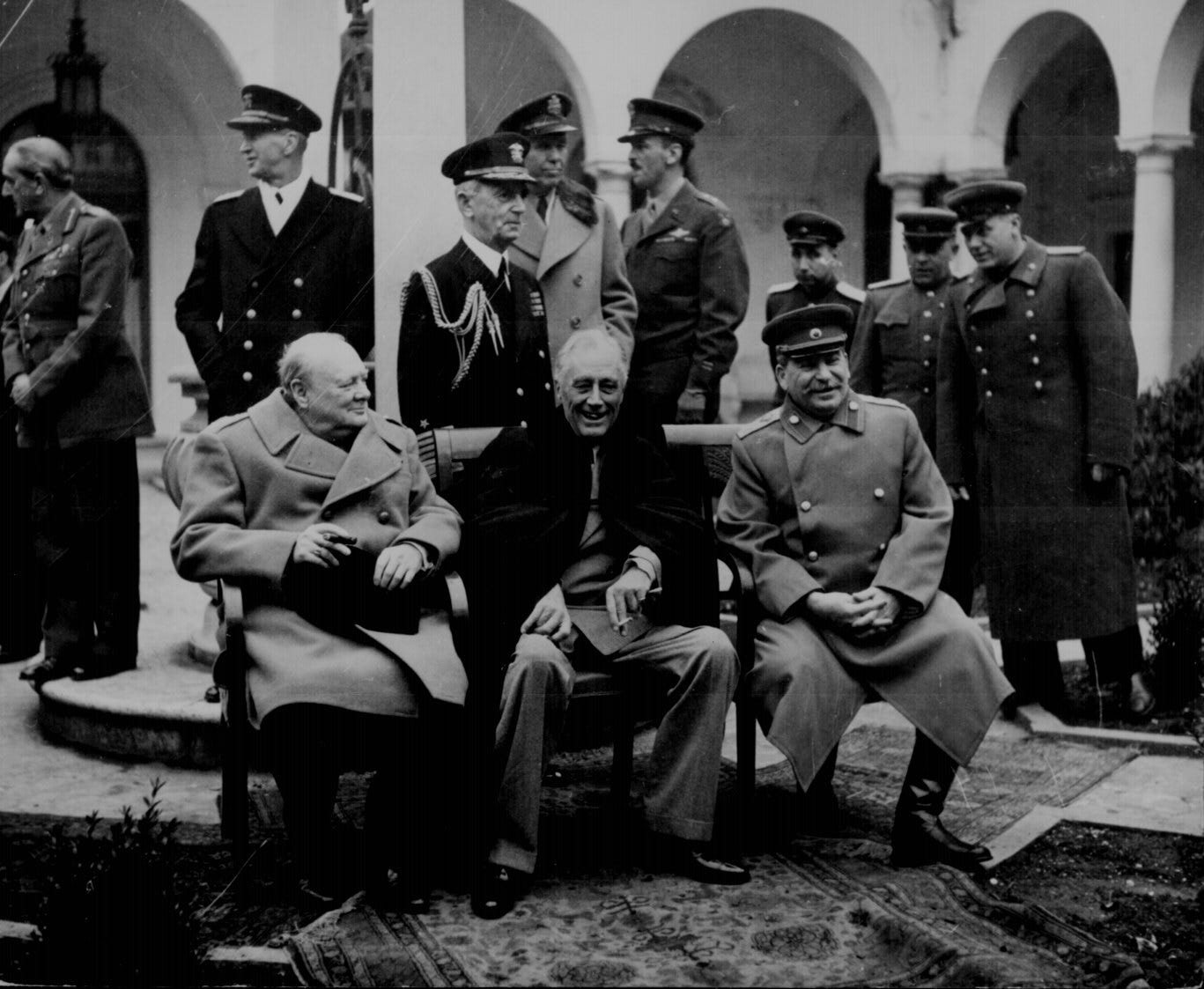
Last time, I described the state of China in August 1945: the territorial map, the economic ruin of the Nationalist government, and the position of the two Chinese forces as Japan surrendered. This time, I want to zoom out to a third player whose role in shaping the outcome of the Chinese civil war has never received the attention it deserves in Western popular history: the Soviet Union, and specifically Josef Stalin. His calculations, strategic, ideological, and deeply personal, ran beneath the surface of every major development from Yalta to the founding of the People’s Republic. Understanding them changes how the whole story reads.
What did Stalin actually want from China?
The answer is not simply a Communist China. Stalin’s goals were more traditional, and in some respects more cynical, than that. He wanted what Russian tsars had wanted before him: warm water ports in the Pacific, control over Manchurian railways, a buffer zone in Outer Mongolia, and a China too divided or too weak to challenge Soviet interests in northeast Asia. A strong, unified China, whether Nationalist or Communist, was not in his interest. A China grateful to the Soviets and dependent on their goodwill was far preferable.
At Yalta, he extracted the following from Roosevelt, formalised later in the Sino-Soviet Treaty of Friendship and Alliance signed with Chiang’s government in August 1945. Outer Mongolia would remain independent, effectively a Soviet satellite, as it had been since the 1920s. The Soviet Union would receive Port Arthur as a naval base for thirty years. Dairen (today known as Dalian), the great Manchurian commercial port, would become a free port under joint Sino-Soviet administration, with Soviet interests protected. The Chinese Eastern Railway and the South Manchurian Railway. the steel arteries of Manchuria’s economy, would be jointly operated. Southern Sakhalin and the Kuril Islands, lost to Japan in the Russo-Japanese War forty years earlier, would be returned to Soviet control.
In exchange, Stalin gave Roosevelt what Roosevelt most needed: a promise to enter the Pacific War within three months of Germany’s defeat, and a promise to support Chiang Kai-shek’s Nationalist government as the legitimate government of China and not to aid the Chinese Communists.
It was a remarkable deal, and not only for its cynicism. Consider what had been traded. Outer Mongolia was territory that the Republic of China had never formally recognised as independent. Port Arthur was a Chinese port. The Manchurian railways ran through Chinese soil and had been the subject of Chinese resentment since the Russians first built them in the 1890s. These were not Stalin’s or Roosevelt’s to give or take. They were Chinese. Roosevelt had swapped Chinese sovereignty for Soviet military commitments without asking a single Chinese whether the trade was acceptable.
When Chiang was finally informed of the Yalta terms in June 1945, his reaction was one of controlled fury. He had been fighting Japan for eight years, had lost hundreds of thousands of soldiers, had seen his country ravaged and had just learned that his principal ally had secretly agreed to restore Russian imperial privileges in China that the Chinese had spent decades trying to remove. He was in no position to refuse. Without American support he could not survive. And Roosevelt, who might have been persuaded to revisit the terms, was already dead.
T.V. Soong went to Moscow and negotiated what he could within the framework Roosevelt had already conceded. He was a skilled diplomat working from a position of almost no leverage. The Sino-Soviet Treaty was signed on August 14th, 1945, the day before Japan’s formal surrender. Stalin had his treaty, his ports, his railways and his buffer. Chiang had Soviet recognition and a Soviet promise of non-interference in Chinese internal affairs. That promise would prove to be worth less than the paper it was signed on.
On August 8th and 9th, two days before Japan’s surrender, the Soviet Union declared war on Japan and launched one of the largest military operations of the entire war. One and a half million Soviet troops invaded Manchuria from three directions simultaneously. They crossed from the Soviet Far East in the east, from Mongolia in the west, and from the north across the Amur River. It was a masterpiece of logistics and coordination, a military operation whose scale dwarfed almost anything happening in the Pacific at that moment. The Kwantung Army — once the most feared Japanese force in Asia, the army that had terrorised Manchuria since 1931, the army that had run Unit 731, had been stripped of its best units to defend the Japanese home islands. What remained was a shadow of its former strength, and it collapsed within days. The campaign that ended Japanese power in Manchuria lasted less than two weeks.
What the Soviet soldiers found in Manchuria was an industrial prize of enormous value. Japan had spent fourteen years and vast capital building Manchuria into the industrial heart of its empire: steel mills, chemical plants, machinery factories, munitions works, power stations, aluminium smelters. The city of Shenyang alone had major industrial facilities that represented decades of investment. The Soviet army took it apart and shipped it home. Teams of Soviet engineers and soldiers worked methodically through the factories: removing machinery, tools, electrical equipment and anything else of industrial value, dismantling what they could not take and loading it onto trains bound for Siberia and the Soviet industrial heartland. (They did something similar in eastern Germany.) The estimates of what was removed vary considerably, but they range from nearly a billion to two billion dollars in industrial equipment at 1945 values. Railway rolling stock went with them. The industrial base that whoever controlled Manchuria would have inherited was systematically stripped before it could be transferred to any Chinese authority.
This was theft on an industrial scale, and Stalin was unapologetic about it. In his view, the Soviet Union had bled for the victory over fascism and was entitled to its spoils. The Chinese, Nationalist or Communist, would have to make their own arrangements.
But the stripping of Manchuria’s industry was not the most consequential thing the Soviets did in the weeks after Japan’s surrender. What mattered more was what they did and did not do with the weapons of the defeated Kwantung Army.
The Kwantung Army had not only men but enormous stockpiles of equipment. Estimates suggest around seven hundred thousand rifles, fourteen thousand artillery pieces, thousands of vehicles, hundreds of aircraft, and significant quantities of tanks and ammunition. This was a military inheritance of extraordinary value for whoever could claim it.
The Soviets did not formally hand it to the Chinese Communists. But they controlled Manchuria, they controlled access to the weapons depots, and they allowed Lin Biao’s Communist forces, who were moving rapidly into Manchuria even as the Soviets arrived, to access what the Japanese had left behind. The precise mechanics of how much was transferred, by what means, and with how much Soviet direction is a matter of historical debate. What is not debatable is the outcome. Lin Biao’s forces entered Manchuria as a guerrilla army and emerged from the experience equipped as a modern military force capable of fighting set-piece battles against the KMT’s best divisions. The artillery that the Communists deployed in the great Manchurian campaigns of 1948 had once belonged to the Kwantung Army.
While this was happening, the Soviets were blocking the Nationalist government’s attempts to reassert control with a precision that could not have been accidental. The Sino-Soviet Treaty gave the Soviets control of Dairen as a free port and their interpretation of that control meant that KMT military forces could not land there. This was not a grey area or a misunderstanding. When American ships carrying Nationalist troops approached Manchurian ports in the autumn of 1945, Soviet officials at Dairen turned them away, citing the treaty’s free port provisions. The KMT was forced to land at Qinhuangdao and other ports further south and west of the key Manchurian cities, adding days and weeks to the time it took to move forces northward. Soviet troops, meanwhile, remained in the cities formally present, formally neutral, and informally making it impossible for the KMT to establish administrative control.
Those weeks and months of delay were not wasted by the Communists. Lin Biao’s forces, moving rapidly through the Manchurian countryside from their base areas in north China, were establishing themselves in the rural interior while the KMT struggled to reach the cities. When the Soviets finally withdrew, the outline of the coming military confrontation in Manchuria was already visible. The KMT held the cities. The Communists, as they had done throughout the war years, held the countryside and the weapons they had inherited from the Kwantung Army meant they could do far more than hold it.
The Soviet withdrawal from Manchuria was supposed to be complete within three months of Japan’s surrender: by December 1945. It was not. The Soviets delayed, repeatedly and transparently, citing various administrative and logistical reasons, until May 1946. By the time they left, Lin Biao’s forces were established across much of the Manchurian countryside and the KMT, despite all American efforts to airlift and ship its forces northward, had been denied the head start that a timely Soviet withdrawal might have provided.
Now to the psychological dimension. Stalin’s behaviour toward the Chinese Communists was not simply that of a patron enabling a client. It was more complicated and, frankly, more interesting than that.
Stalin did not trust Mao Zedong. He had not trusted the Chinese Communists for decades, and with some reason from his own perspective. They had repeatedly ignored Comintern advice when it suited them, and Mao in particular had built his power precisely by rejecting the Soviet-aligned faction within the CCP. We covered the Rectification Campaign in an earlier episode. That campaign had been in part a purge of the Comintern-trained wing of the party. Stalin understood what that meant.
The history of Soviet advice to the Chinese Communists was, on Stalin’s side, a history of instructions that had repeatedly served Soviet interests rather than Chinese Communist ones. In 1927, it was Stalin who had pushed the Communists to remain inside the Nationalist party even as Chiang Kai-shek’s intentions became clear. That was a policy that led directly to the massacres that nearly destroyed the CCP entirely. In 1941, it was Stalin who signed the Soviet-Japanese Neutrality Pact and publicly accepted Japanese control of Manchukuo and north China, leaving the Chinese Communists diplomatically isolated at a critical moment. Throughout the war, Soviet support had been conditional, limited, and always calibrated to what suited Moscow rather than Yan’an.
More fundamentally, Stalin doubted that the Chinese Communists were genuine Marxist-Leninists. He had called them, on at least one occasion, margarine Communists: artificial, not the real thing. A party whose revolutionary base was the peasantry rather than the urban proletariat did not fit the Marxist-Leninist template cleanly. He had always found Mao’s theoretical independence irritating and politically suspicious. A leader who had risen by defying Soviet-backed factions within his own party was not, in Stalin’s experience, a leader who would remain reliably deferential to Moscow once he no longer needed it.
What Stalin wanted from China, was not a strong Communist ally. It was a China that needed him: a China that was divided, grateful, and dependent on Soviet goodwill. His preferred outcome for the Chinese civil war, for much of its duration, was probably a Korea-style division: Communists in the north, Nationalists in the south, both looking to Moscow and Washington respectively, neither strong enough to challenge Soviet interests in Manchuria.
When the military tide turned decisively toward the Communists in 1948 and it became clear that Mao might actually win the whole country, Stalin reassessed. Even then, he was cautious. He reportedly advised Mao against crossing the Yangtze in 1949. He warned that American intervention might follow, as it had in Korea. Mao ignored the advice, crossed the Yangtze, and proved Stalin wrong. The Nationalist government collapsed. There was no American intervention. Stalin had misjudged both Mao’s determination and American restraint.
The relationship between Stalin and Mao never lost its underlying tension. When Mao travelled to Moscow in December 1949, his first journey outside China, Stalin kept him waiting for days before serious discussions began. The negotiations for the new Sino-Soviet Treaty took weeks and were reportedly bruising. Mao later described the experience as like trying to take meat from the mouth of a tiger. The treaty that emerged in February 1950 gave China Soviet technical assistance, recognised Chinese sovereignty over Manchuria in principle, and established a formal alliance. But Soviet privileges in Port Arthur and Dairen were maintained for years, and the terms reflected a relationship between an uncertain patron and a newly powerful client who each needed the other less than they let on. Several thousand Soviet advisors and technical specialists came to China in the early 1950s and made genuine contributions to Chinese industrial and military development. But the relationship was never one of equals, and Mao did not forget it.
Stalin died in March 1953. The Sino-Soviet alliance he had constructed outlasted him by only a few years. By the late 1950s, Mao and Khrushchev were openly at odds, over ideology, over nuclear weapons sharing, over who led the Communist world, and over the specific question of how to deal with the United States. Khrushchev’s denunciation of Stalin’s cult of personality in 1956 alarmed Mao, whose own cult of personality was being actively reconstructed at that very moment. The implication, that personality cults were dangerous distortions of socialist governance, was one that Mao could not accept without undermining his own authority.
Soviet advisors were withdrawn from China in 1960, taking their technical blueprints with them, deliberately leaving Chinese industrial and military projects half-finished. The split became public and vicious. The two largest Communist states spent much of the 1960s denouncing each other in terms that were often more heated than anything either directed at the United States. In 1969, they actually fought a brief but deadly border war along the Ussuri River in the Russian Far East (the river that forms the boundary between China and Russia in Manchuria, the very territory whose control had been at the heart of the Yalta negotiations twenty-four years earlier). Soviet troops massed along the Chinese border in numbers that alarmed Beijing genuinely. Mao, in the year before Nixon’s famous visit to China, was more frightened of the Soviet Union than of the United States.
The Sino-Soviet split is another story. But it is worth noting here, as we close this chapter, that the seeds of that split were planted in the very relationship we have been examining. Mao never forgot that Stalin had doubted him, delayed recognising him, tried to limit him, stripped Manchuria of its industry, and extracted what he could from China in exchange for support that was always conditional and never quite what it appeared. The alliance of 1950 was built on a foundation of mutual suspicion that time would erode rather than strengthen.
Today, China and Russia present themselves to the world as a partnership, bound by shared opposition to American power and Western liberal values. Vladimir Putin and Xi Jinping have signed documents proclaiming a friendship with no limits. The two countries coordinate at the United Nations, share intelligence, and present a common front in international forums. Russia provides China with energy and some military technology. China provides Russia with economic relief from Western sanctions imposed after the invasion of Ukraine.
But students of this history will recognise the pattern. The relationship is one of convenience between two powers whose fundamental interests do not align. They may want each other as a counterweight to the West but harbour deep mutual suspicions. That is rooted in centuries of rivalry over Central Asia and the Russian Far East, and in the specific betrayals and manipulations of the 1940s and 1950s that we have been examining. Russia still holds territories seized from China in the unequal treaties of the nineteenth century. China has not forgotten this, even if it does not say so publicly. The no-limits friendship announced in February 2022, just before Russia’s full-scale invasion of Ukraine, has been tested by the realities of that war and has proven to have rather visible limits. China has not provided Russia with all that Moscow has requested. The economic relationship is real. The strategic alignment is selective.
Stalin shaped the founding of the People’s Republic more than almost any outside actor. He did so not out of Communist solidarity but out of Russian national interest and in ways that planted the contradictions that would eventually fracture the relationship entirely. That is, in its way, a fitting epitaph for a partnership that was never what either side claimed it was.
Image: "Public Domain: WWII: Big Three at Yalta (NARA)" by pingnews.com is marked with Public Domain Mark 1.0.